Scheduled Wastes Regulations 2005
Key information
- Source
- DOE - P.U. (A) 294
- Gazette
- P.U. (A) 294/2005
- Commencement
- 15 August 2005
Scheduled Wastes Regulations 2005: Regulates the storage, management, and disposal of scheduled wastes in Malaysia.
Preamble
Regulation 1. Citation and commencement
- (1)These regulations may be cited as the Environmental Quality (Scheduled Wastes) Regulations 2005.
- (2)These Regulations come into operation on 15 August 2005.
Regulation 2. Interpretation
- (1)In these Regulations, unless the context otherwise requires—
- “scheduled wastes”
- means any waste falling within the categories of waste listed in the First Schedule ;
- “incompatible scheduled wastes”
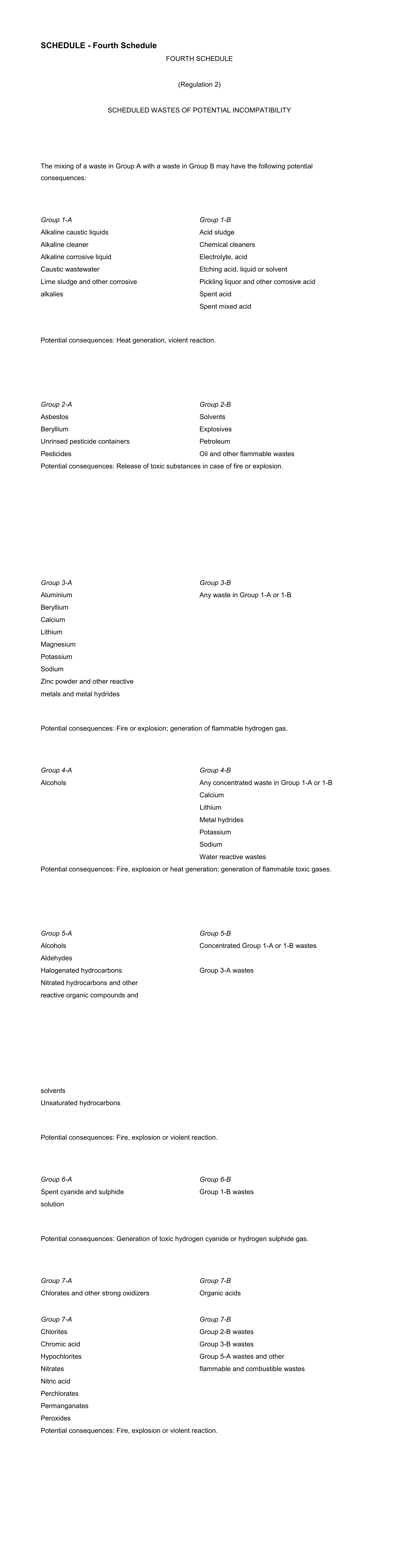
- means scheduled wastes specified in the Fourth Schedule which, when mixed, will produce hazardous situations through heat generation, fires, explosions or the release of toxic substances;
- “on-site treatment facility”
- means a facility, other than a scheduled wastes incinerator or a land treatment facility, located on a waste generator's site and that is used solely to deal with scheduled wastes produced on that site;
- “contractor”
- means any person licensed by the Director General of Environmental Quality under subsection 18(1A) of the Act;
- “waste generator”
- means any person who generates scheduled wastes;
- “prescribed premises”
- means premises prescribed by the Environmental Quality (Prescribed Premises) (Scheduled Wastes Treatment and Disposal Facilities) Order 1989 [P.U. (A) 140/1989].
- (2)Words and expressions which are not defined in these Regulations shall have the same meaning as assigned to them in the Act and in the Environmental Quality (Prescribed Premises) (Scheduled Wastes Treatment and Disposal Facilities) Order 1989.
Regulation 3. Notification of the generation of scheduled wastes
- (1)Every waste generator shall, within 30 days from the date of generation of scheduled wastes, notify the Director General of the new categories and quantities of scheduled wastes which are generated.
- (2)The notification given under subregulation (1) shall include the information provided in the Second Schedule .
Regulation 4. Disposal of scheduled wastes
- (1)Scheduled wastes shall be disposed of at prescribed premises only.
- (2)Scheduled wastes shall, as far as is practicable, be rendered innocuous prior to disposal.
Regulation 5. Treatment of scheduled wastes
- (1)Scheduled wastes shall be treated at prescribed premises or at on-site treatment facilities only.
- (2)Residuals from treatment of scheduled wastes shall be treated or disposed of at prescribed premises.
Regulation 6. Recovery of material or product from scheduled wastes
- (1)Recovery of material or product from scheduled wastes shall be done at prescribed premises or at on-site recovery facilities.
- (2)Residuals from recovery of material or product from scheduled wastes shall be treated or disposed of at prescribed premises.
Regulation 7. Application for special management of scheduled wastes
- (1)A waste generator may apply to the Director General in writing to have the scheduled wastes generated from their particular facility or process excluded from being treated, disposed of or recovered in premises or facilities other than at the prescribed premises or on-site treatment or recovery facilities.
- (2)An application under subregulation (1) shall be submitted to the Director General in accordance with the guidelines for special management of scheduled wastes as prescribed by the Director General and shall be accompanied by fee of three hundred ringgit and shall not be refunded.
- (3)If the Director General is satisfied with the application made under subregulation (1), the Director General may grant a written approval either with or without conditions.
Regulation 8. Responsibility of waste generator
- (1)Every waste generator shall ensure that scheduled wastes generated by him are properly stored, treated on-site, recovered on-site for material or product from such scheduled wastes or delivered to and received at prescribed premises for treatment, disposal or recovery of material or product from scheduled wastes.
- (2)Every waste generator shall ensure that scheduled wastes that are subjected to movement or transfer be packaged, labelled and transported in accordance with the guidelines prescribed by the Director General.
Regulation 9. Storage of scheduled wastes
- (1)Scheduled wastes shall be stored in containers which are compatible with the scheduled wastes to be stored, durable and which are able to prevent spillage or leakage of the scheduled wastes into the environment.
- (2)Incompatible scheduled wastes shall be stored in separate containers, and such containers shall be placed in separate secondary containment areas.
- (3)Containers containing scheduled wastes shall always be closed during storage except when it is necessary to add or remove the scheduled wastes.
- (4)Areas for the storage of the containers shall be designed, constructed and maintained adequately in accordance with the guidelines prescribed by the Director General to prevent spillage or leakage of scheduled wastes into the environment.
- (5)Any person may store scheduled wastes generated by him for 180 days or less after its generation provided that—
- (a)the quantity of scheduled wastes accumulated on site shall not exceed 20 metric tonnes;
- (b)the Director General may at any time, direct the waste generator to send any scheduled wastes for treatment, disposal or recovery of material or product from the scheduled wastes up to such quantity as he deems necessary.
- (a)
- (6)A waste generator may apply to the Director General in writing to store more than 20 metric tonnes of scheduled wastes.
- (7)If the Director General is satisfied with the application made under subregulation (6), the Director General may grant a written approval either with or without conditions.
Regulation 10. Labelling of scheduled wastes
- (1)The date when the scheduled wastes are first generated, name, address and telephone number of the waste generator shall be clearly labelled on the containers that are used to store the scheduled wastes.
- (2)Containers of scheduled wastes shall be clearly labelled in accordance with the types applicable to them as specified in the Third Schedule and marked with the scheduled waste code as specified in the First Schedule for identification and warning purposes.
- (3)No person is allowed to alter the markings and labels mentioned in subregulations (1) and (2).
Regulation 11. Waste generator shall keep an inventory of scheduled wastes
- A waste generator shall keep accurate and up-to-date inventory in accordance with the Fifth Schedule of the categories and quantities of scheduled wastes being generated, treated and disposed of and of materials or product recovered from such scheduled wastes for a period up to three years from the date the scheduled wastes was generated.
Regulation 12. Information to be provided by waste generator, contractor and occupier of prescribed premises
- (1)A waste generator, contractor and occupier of the prescribed premises shall provide information in accordance with the Sixth Schedule in the manner provided in this regulation or Director General shall determine other method as he thinks fit.
- (2)A waste generator shall complete Part I of the Sixth Schedule in six copies and hand over the six copies of the Schedule to the contractor when the scheduled wastes are delivered to him.
- (3)The contractor shall, upon receiving scheduled wastes from a waste generator, complete Part II of the Sixth Schedule in the six copies given to him by the waste generator and shall thereafter immediately hand over two copies of the Schedule to the waste generator who in turn shall submit a copy to the Director General within 30 days from the date of transportation of the scheduled wastes.
- (4)The contractor shall within 10 days from the date of receipt of the scheduled wastes deliver the scheduled wastes to the occupier of any prescribed premises and hand over the remaining four copies of the Sixth Schedule to the occupier.
- (5)The occupier of any prescribed premises shall, upon receiving scheduled wastes from the contractor, complete Part III of all the remaining four copies of the Sixth Schedule handed over to him by the contractor and shall, upon completion, retain one copy and return a copy each to the contractor, the waste generator and the Director General, within 20 days from the date of receipt of the scheduled wastes.
- (6)If the waste generator fails to receive his copy of the Sixth Schedule from the occupier of the prescribed premises referred to in subregulation (5) within 30 days from the date of delivery of the scheduled wastes to the contractor referred to in subregulation (2), he shall notify the Director General immediately and shall investigate and inform the Director General of the result of his investigation.
- (7)The waste generator, contractor or occupier of the prescribed premises shall each keep a signed copy of the Sixth Schedule which shall be retained as a record for at least three years from the date the scheduled wastes are received by the occupier of the prescribed premises.
Regulation 13. Scheduled wastes transported outside waste generator's premises to be accompanied by information
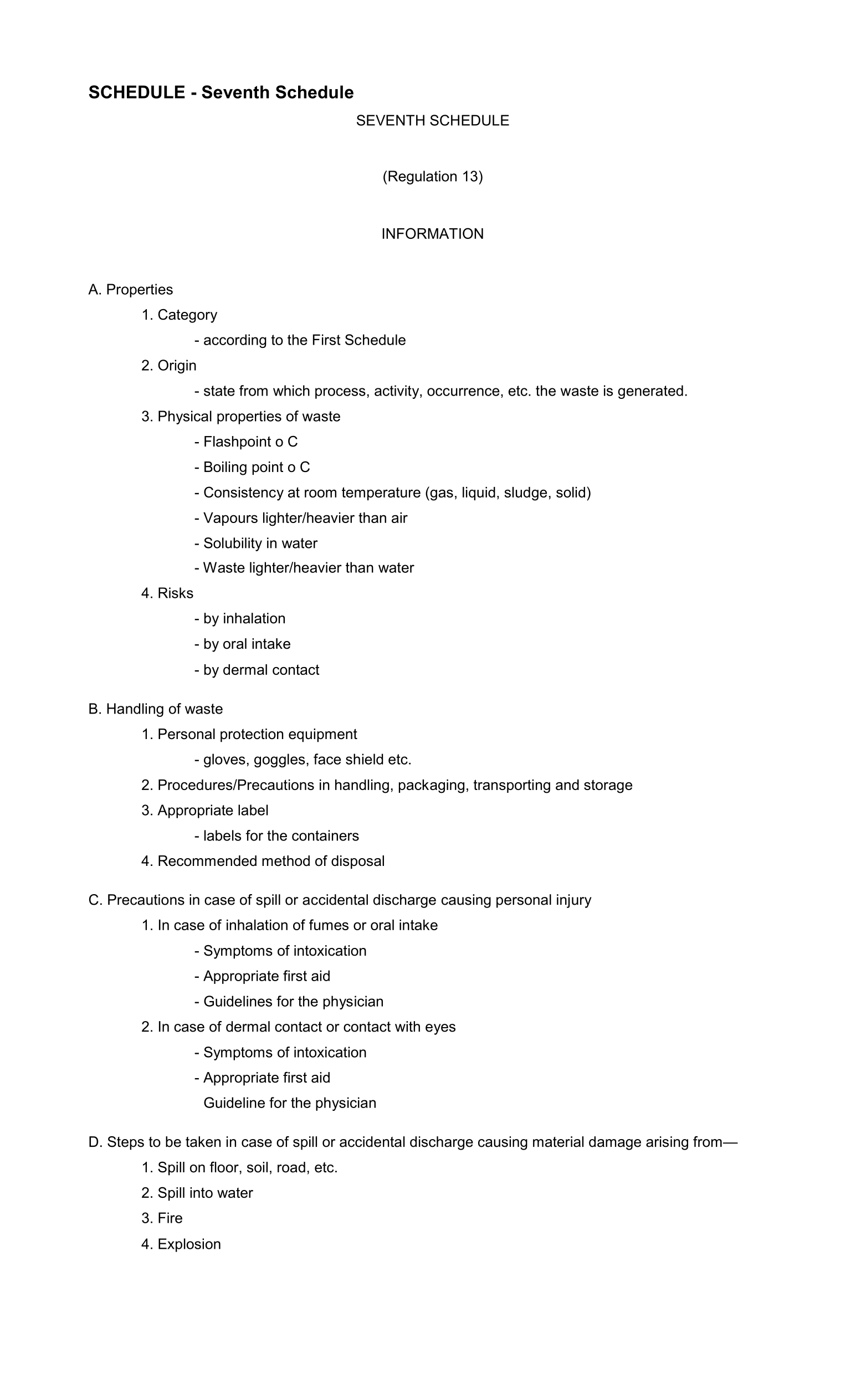
- (1)Every waste generator shall provide information in accordance with the Seventh Schedule in respect of each category of scheduled wastes to be delivered to the contractor and shall give the Schedule to the contractor upon delivery of the waste to him.
- (2)The waste generator shall inform the contractor of the purpose and use of the Seventh Schedule.
- (3)The contractor shall carry with him the Seventh Schedule for each category of scheduled wastes being transported and shall observe and comply with the instructions contained therein.
- (4)The contractor shall, in the selection of transportation routes, as far as possible avoid densely populated areas, water catchment areas and other environmentally sensitive areas.
- (5)The contractor shall ensure that all his employees that are involved in the handling, transportation and storage of scheduled wastes attend training programmes.
- (6)The contractor shall ensure that during the training programme each employee is well informed of the purpose and use of the Seventh Schedule.
Regulation 14. Spill or accidental discharge
- (1)In the event of any spill or accidental discharge of any scheduled wastes, the contractor responsible for the waste shall immediately inform the Director General of the occurrence.
- (2)The contractor shall do everything that is practicable to contain, cleanse or abate the spill or accidental discharge and to recover substances involved in the spill or accidental discharge.
- (3)The waste generator shall provide technical expertise and supporting assistance in any clean-up operation referred to in subregulation (2).
- (4)The contractor shall undertake studies to determine the impact of the spillage or accidental discharge on the environment over a period of time to be determined by the Director General.
Regulation 15. Conduct of training
- Every waste generator shall ensure that all his employees involved in the identification, handling, labelling, transportation, storage and spillage or discharge response of scheduled wastes attend training programmes.
Regulation 16. Compounding of offences
- (1)Every offence which consists of any omission or neglect to comply with, or any act done or attempted to be done contrary to these Regulations may be compounded under section 45 of the Act.
- (2)The compounding of offences referred to in subregulation (1) shall be in accordance with the procedure prescribed in the Environmental Quality (Compounding of Offences) Rules 1978 [P.U. (A) 281/1978].
Regulation 17. Revocation
- The Environmental Quality (Scheduled Wastes) Regulations 1989 [P.U. (A) 139/1989] is revoked.
First Schedule (Regulation 2) — Categories of scheduled waste
SW 1 Metal and metal-bearing wastes
SW 2 Wastes containing principally inorganic constituents which may contain metals and organic materials
SW 3 Wastes containing principally organic constituents which may contain metals and inorganic materials
SW 4 Wastes which may contain either inorganic or organic constituents
SW 5 Other wastes
Second Schedule (Regulation 3) — Notification of scheduled wastes
NOTIFICATION OF SCHEDULED WASTES
| For office use only | |
|---|---|
| File Reference No. | File reference number |
| Waste Generator Code: | Waste generator codePrescribed blank with 15 character boxes. |
| State Code: | State codePrescribed blank with 3 character boxes. |
1. IDENTIFICATION
2. PRODUCTION DATA
List of raw materials/chemicals and quantities used per month*
| Raw Material/Chemicals | Quantity (Metric Tonnes) |
|---|---|
Raw material or chemical | Material quantity |
Raw material or chemical | Material quantity |
Raw material or chemical | Material quantity |
Raw material or chemical | Material quantity |
Raw material or chemical | Material quantity |
3. WASTE DATA
Scheduled wastes generated per month**
| Waste Category Code | Waste Source¹ | Name of Waste | Waste Component² | Quantity (Tonnes/Month)³ |
|---|---|---|---|---|
Waste data row 1, column 1 | Waste data row 1, column 2 | Waste data row 1, column 3 | Waste data row 1, column 4 | Waste data row 1, column 5 |
Waste data row 2, column 1 | Waste data row 2, column 2 | Waste data row 2, column 3 | Waste data row 2, column 4 | Waste data row 2, column 5 |
Waste data row 3, column 1 | Waste data row 3, column 2 | Waste data row 3, column 3 | Waste data row 3, column 4 | Waste data row 3, column 5 |
Waste data row 4, column 1 | Waste data row 4, column 2 | Waste data row 4, column 3 | Waste data row 4, column 4 | Waste data row 4, column 5 |
Note: 1 Unit Operation in the process/plant 2 Name the elements, compound or material 3 Guide to conversion (only data in metric tonnes/month is acceptable) * Use additional sheet if required ** Estimates
I certify that the information provided is true and correct to the best of my knowledge.
Note: *** Reporting officer refers to the person handling scheduled wastes.
Third Schedule (Regulation 10) — Labelling requirement for scheduled wastes

Fourth Schedule (Regulation 2) — Scheduled wastes of potential incompatibility
Fifth Schedule (Regulation 11) — Inventory of scheduled wastes
INVENTORY OF SCHEDULED WASTES
| * Dateᵃ | *Waste Category Code | *Name of Waste | *Quantity Generated (Metric Tonnes) | *Waste Handling | ||
|---|---|---|---|---|---|---|
| Methodᵇ | Quantity in Metric Tonnes | Placeᶜ | ||||
Inventory row 1, column 1 | Inventory row 1, column 2 | Inventory row 1, column 3 | Inventory row 1, column 4 | Inventory row 1, column 5 | Inventory row 1, column 6 | Inventory row 1, column 7 |
Inventory row 2, column 1 | Inventory row 2, column 2 | Inventory row 2, column 3 | Inventory row 2, column 4 | Inventory row 2, column 5 | Inventory row 2, column 6 | Inventory row 2, column 7 |
Inventory row 3, column 1 | Inventory row 3, column 2 | Inventory row 3, column 3 | Inventory row 3, column 4 | Inventory row 3, column 5 | Inventory row 3, column 6 | Inventory row 3, column 7 |
Inventory row 4, column 1 | Inventory row 4, column 2 | Inventory row 4, column 3 | Inventory row 4, column 4 | Inventory row 4, column 5 | Inventory row 4, column 6 | Inventory row 4, column 7 |
Note: * Inventory of the current generation of scheduled wastes a Date when the scheduled wastes are first generated b Stored, processed, recovered for materials or product from such scheduled wastes, incinerated, exchanged or other methods (specify) c Give name and address of the facility
I hereby declare that all information given in this form is to the best of my knowledge and belief true and correct in all respect.
Sixth Schedule (Regulation 12) — Consignment note for scheduled wastes
CONSIGNMENT NOTE FOR SCHEDULED WASTES
I WASTE GENERATOR
- Solid
- Sludge
- Liquid
- Pallet Container
- Canister
- 55 gallon Drum
- Other (specify)
II CONTRACTOR
- No
- Yes, Address:
III STORAGE/TREATMENT/
RECOVERY/DISPOSAL/
FACILITY OPERATOR
- Storage
- Regrouping
- Recovery
- Landfill
- Secure Landfill
- Physical/Chemical Treatment
- Incinerator
- Other (specify)
Seventh Schedule (Regulation 13) — Information